
There is a category of problems that is so universal, so mundane, and so consistently under engineered that most people don’t even recognize it as an unsolved problem. They just accept failure as the natural order of things.
Sanitation access is that problem.
No sanitation in your home. Not sanitation in a well-funded office building or a modern hospital. Sanitation at the edge, where infrastructure runs out, where crowds overwhelm capacity, where missions take people to places that pipes have never reached and never will. That’s where the system breaks down, every single time, and has been breaking down for as long as human beings have been operating in difficult environments.
The Urinup™ Autonomous Model is our answer to that breakdown. And to understand why it has to be autonomous, why anything less ambitious won’t actually solve the problem, you need to understand the full scope of where the problem exists.
The Edge of Infrastructure
Think about the last time sanitation access failed around you. Maybe it was a stadium bathroom line so long you missed the first quarter coming back. Maybe it was a festival porta-potty situation that required genuine courage. Maybe you’ve read about the logistics of field sanitation in combat deployment, or the conditions in a hurricane evacuation shelter three days after landfall, or what it means to be an elderly person living alone who can no longer safely walk to the bathroom at night.
These feel like different problems. They’re not. They all have the same problem wearing different clothes: a person who needs hygiene sanitation access, in a place or moment where the infrastructure doesn’t match the need.
The scale of that problem is staggering.
Every year, military personnel operate in thousands of forward bases and combat outposts where sanitation logistics are a genuine operational challenge. Every hurricane season, hundreds of thousands of displaced people cycle through shelters where portable facilities are overwhelmed within hours. Every weekend, stadiums and arenas and concert venues push restroom infrastructure to its limits while lines grow and experiences suffer. Every day, aging and mobility-impaired individuals navigate the physical and psychological burden of inadequate sanitation solutions that treat dignity as optional.
And beyond Earth, a generation from now, if the timelines of NASA’s Artemis program and SpaceX’s Mars ambitions hold, human beings will be living in habitats where the nearest plumber is 140 million miles away.
All of these environments share the same engineering constraint: the infrastructure you’re used to isn’t there. The solution has to bring everything with it.
Why Existing Solutions Don’t Scale
The current toolkit for portable sanitation was designed for one person at a time, in a single static location, with regular human service. It works adequately in low-demand, low-stakes situations. It fails everywhere else.
Single-occupancy porta-potties require pump-out trucks, dedicated ground space, permits, and a service schedule. They can’t be moved during an event. They can’t reposition themselves based on where the crowd is. They can’t clean themselves between uses. They’re fundamentally passive objects that create as many logistical problems as they solve.
Personal handheld urinal bottles and disposable bags are better than nothing, but they serve one person at a time, they’re stigmatizing in most social contexts, and they generate waste that has to be managed manually.
None of these solutions work at a military forward operating base in a contested environment where a service vehicle can’t get through. None of them work in a Mars habitat. None of them work in a stadium where 80,000 people all want to use the restroom at the same time during halftime.
The problem needs fundamentally different architecture. And critically, the components of that architecture don’t all have to be invented from scratch. They already exist. They’re just sitting in the wrong industry.
The Overlooked Toolkit: Borrowing From Biotech and Modular Design
Here is something the portable sanitation industry has never had much incentive to ask: what if the solution to high-demand, low-infrastructure sanitation isn’t a better porta-potty, but a convergence of technologies from completely different fields?
Biotech already has responses to biological fluid management that go far beyond mechanical containment. Enzymatic and antimicrobial treatments can neutralize pathogens and odor at the molecular level. Hydrophobic and self-cleaning surface coatings, developed for medical devices and food processing equipment, can dramatically reduce the contamination burden between uses. Detachable, sterile enclosure systems borrowed from modular cleanroom design can make privacy and hygienic isolation genuinely portable rather than structurally fixed.
None of these technologies are exotic. They exist, they’re proven, and they’ve been deployed at scale in healthcare, aerospace, and food safety contexts for years. They simply haven’t been applied to portable sanitation, because the companies that dominate that market have had no commercial reason to challenge their own model. A business built on pump-out service contracts doesn’t benefit from inventing a system that never needs pumping out.
CapaciFlow has no legacy model to protect. That’s not a weakness; it’s the only position from which genuine cross-disciplinary innovation is actually possible.
The Autonomous Urinup™ is being designed from the outset to take advantage of this convergence: biotech-informed waste treatment, antimicrobial material science, detachable modular enclosures, and robotic systems, all brought together in a single platform that reconciles four things the sanitation industry has historically treated as incompatible tradeoffs: privacy, hygiene, safety, capacity, and dignity.
Even if that means challenging the interests that have kept those tradeoffs in place.
What Architecture Has to Be
If you’re designing a sanitation system that has to work across all of these environments, from a campground in Colorado to a training camp in the desert to a lunar base, the requirements converge on a very specific set of characteristics.
Dual occupancy. One unit serving two people simultaneously isn’t a luxury feature, it’s a throughput multiplier that halves the number of units you need to deploy, halves the footprint, halves the cost, and halves the maintenance burden.
Dual mode. In environments with any existing sanitation infrastructure, a pass-through funnel mode that requires zero maintenance between uses and zero waste collection is operationally superior to any tank-based system. In environments with no infrastructure at all, disaster zones, remote bases, off-world habitats, a fully self-contained tank mode is the only option. A system that can do both, in a single unit, serves every environment.
Full portability. Wheels aren’t a convenience, they’re capability. A system that can be repositioned in real time, moved to where demand is highest, deployed without construction and removed without a trace is categorically different from fixed or semi-fixed infrastructure.
Autonomy. This is where the architecture takes its final step. A system that requires human intervention to clean, to reposition, to manage its waste, and to service itself between uses is still a passive object with human dependency. A system that does all of that on its own, that navigates to its station, detects and accommodates its users, cleans itself after each use, monitors its own fill level, and signals when it needs attention, is infrastructure that works even when there’s nobody available to run it.
That last requirement is what makes this relevant to Mars. And what makes it far superior to anything currently available on Earth.
The Autonomous Model – From Earth to Off-World
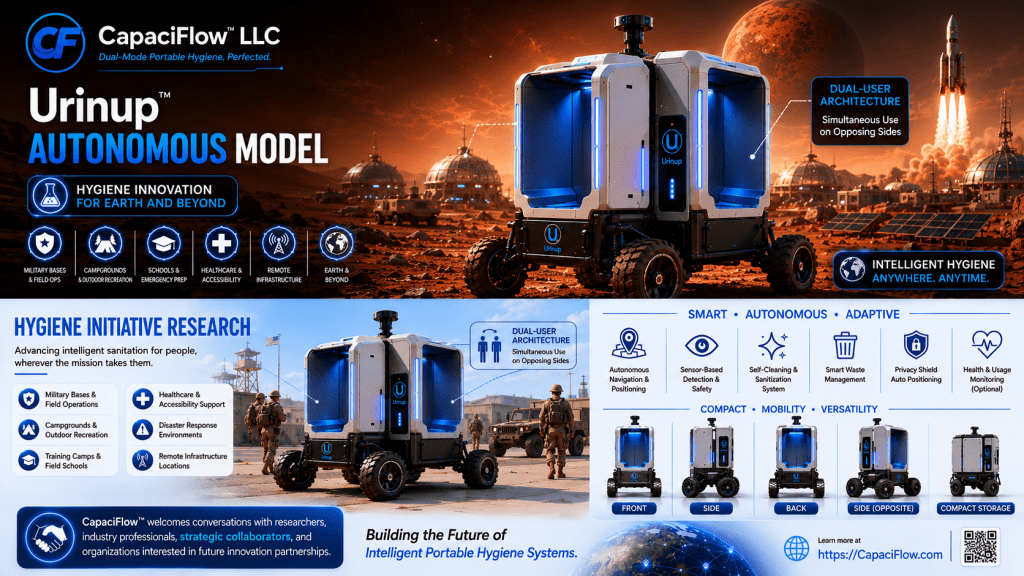
The Urinup™ Autonomous Model begins with the Men’s Double Edition, the dual-occupancy, full-privacy, standing-use unit with rotational mold and aluminum construction, and adds the full autonomous systems layer that transforms it from a portable object into a self-operating platform. And the Men’s Double Edition is only the beginning: an Autonomous Women’s Edition is already on the horizon, bringing the same self-operating intelligence to seated dual-occupancy use, because the future of intelligent sanitation belongs to everyone.
Autonomous Navigation & Positioning – motorized drive system with obstacle detection and spatial awareness, capable of navigating corridors, thresholds, and high-traffic environments to reach its designated station.
Sensor-Based User Detection & Safety – proximity and occupancy detection ensures the unit is ready when a user approaches and secure during use.
Self-Cleaning & Hygiene System – automated post-use cleaning cycle using UV-C disinfection or electrolyzed water misting, eliminating the need for manual cleaning between users.
Smart Waste Management – fill-level sensing, autonomous emptying trigger logic, and sealed waste transfer that prevents contamination.
Privacy Shield Auto-Positioning – enclosure panels that automatically configure for use and retract for storage and transit.
Health & Usage Monitoring (Optional) – IoT telemetry for fleet management, usage analytics, and predictive maintenance, on Earth for venue operators, and eventually for habitat support system integration.
This is the engineering brief. It is technically demanding, genuinely multi-disciplinary, and exactly the kind of problem that benefits from a formal research partnership and federal SBIR/STTR funding. We are in early exploratory discussions with a leading university about that path forward.
The Deployment Map
Two flyers tell the story of where this technology belongs.
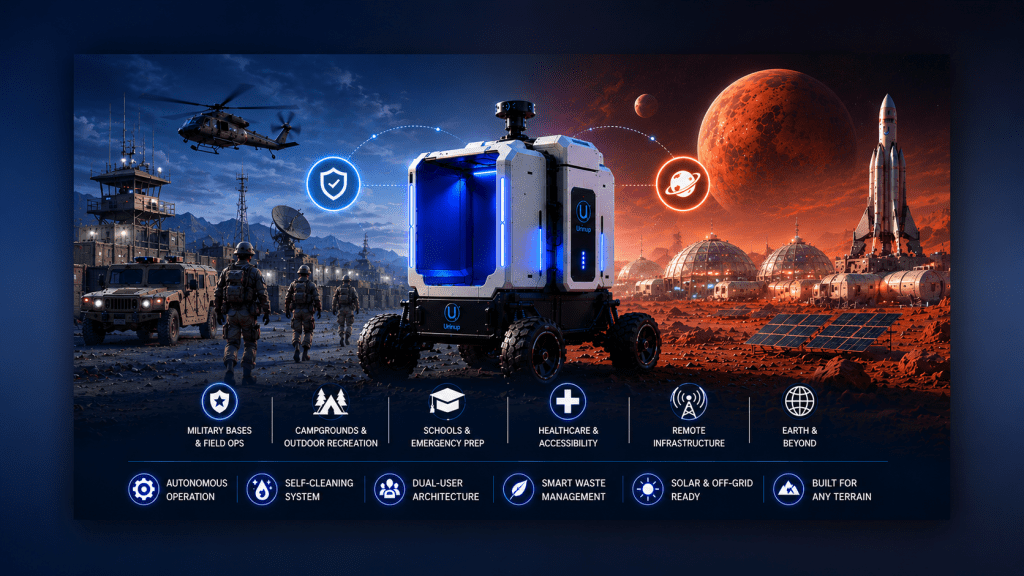
The first shows the Mars surface, a concept render of the Autonomous Model operating on red terrain, with a rocket on the launch pad in the background. Off-world habitats, lunar base modules, SpaceX Starship crew environments.
The second shows Earth, a military base with soldiers and a helicopter overhead, a campground with mountains in the background, and a training camp with recruits running in formation. Grounded, recognizable, immediate.
Together they describe the full deployment map:
Military & Defense – active bases, forward operating bases, training camps, field operations, naval vessels, special operations staging areas.
Emergency & Disaster Response – hurricane shelters, earthquake response zones, flood displacement camps, FEMA sites, refugee camps, mass casualty staging areas.
Outdoor Events & Recreation – festivals, concerts, marathons, national parks, campgrounds, sporting events, scout camps.
Healthcare & Accessibility – nursing homes, assisted living, post-surgical recovery, mobile medical clinics, home health settings.
Construction & Industrial – drilling platforms, offshore rigs, mining operations, pipeline corridors, remote industrial sites.
Developing World & Infrastructure-Limited Regions – rural communities without plumbing, post-conflict reconstruction zones, NGO field operations, sanitation crisis response.
Off-World – ISS, NASA Artemis lunar habitats, SpaceX Starship Mars surface missions, ESA Moon Village, deep space crew vessels, Mars colonist settlements.
Every one of these environments is, at its core, the same problem: a person who needs sanitation access where the infrastructure doesn’t exist. The Autonomous Model is the single engineering answer designed to work across all of them.
We’re Building It Now
CapaciFlow is a founder-stage company. The core Urinup™ product line is in manufacturing development with reservations open. The Autonomous Model is a long-term, multi-phase research initiative, honest about its timeline, serious about its ambition.
We’re looking for the people who want to help build it: engineers, robotics researchers, faculty co-investigators, manufacturing partners, healthcare technology professionals, and strategic collaborators who understand that the most consequential infrastructure problems are the ones everyone else overlooked.
The future of sanitation is autonomous, dual-occupancy, and infrastructure-free. It works on a military base, a campground, a disaster relief camp, and a Martian habitat, because the engineering constraint is the same in all of them.
We’re building it. Come join us.
CapaciFlow™ LLC capaciflow.com | research@capaciflow.com
Urinup™ is a patent-pending product line. The Autonomous Model is in early-stage research and development. No autonomous product has been finalized or announced. Reservations for the core product line are open at capaciflow.com.
 CapaciFlow™
Leave a comment