
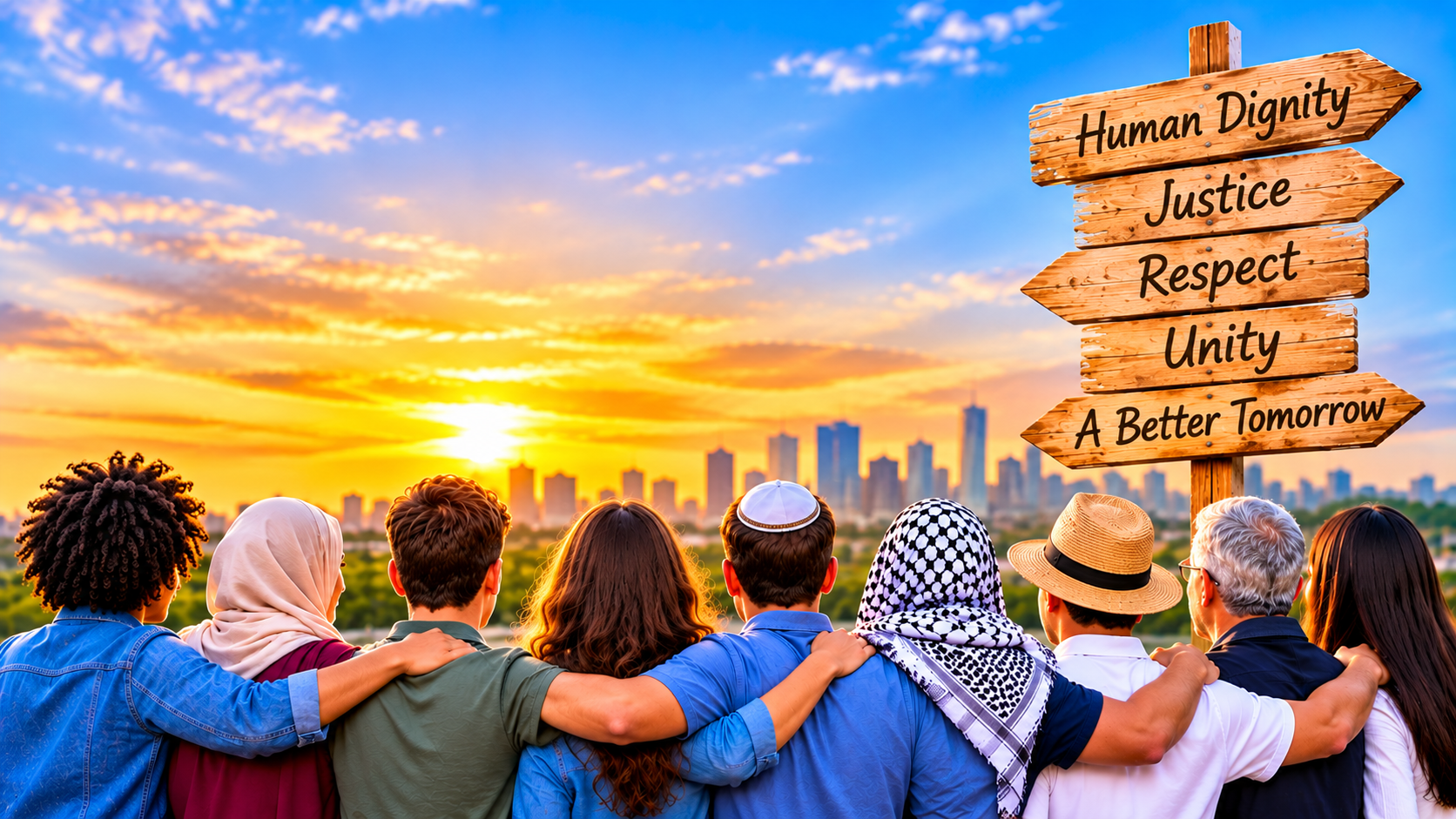
Some personal thoughts about public responsibility, ordinary people, and why standing up for humanity should never depend on which side someone belongs to.
Lately, I’ve been thinking about how difficult it has become for people to express an opinion, take a position, or even decide not to comment on certain issues without being judged by others.
Take Ed Sheeran, for example. The controversy surrounding him made me think about the expectations we place on public figures. Should an artist be expected to speak about every conflict or humanitarian crisis? If they speak, some people may criticize what they say. If they remain silent, others may criticize them for that, too.
I don’t pretend to have the answer to every situation. But I do believe we should leave room for people to think, learn, and make their own decisions about when and how to speak. We can disagree with someone without making them an enemy.
The recent election of Abdul El-Sayed in Michigan also got me thinking. His victory is historic, particularly because of what it represents for Muslim representation in American public life. But what interests me beyond the headline is a bigger question: Can we get better at looking beyond someone’s name, religion, background, or identity and actually consider the person, their ideas, and what they stand for?
I also think there is another side to this that deserves attention. Both Abdul El-Sayed and Zohran Mamdani have made efforts to address concerns in the Jewish community. But I can understand why some Jewish people may still feel those efforts have not gone far enough. Their concerns deserve to be heard. Jewish communities have faced antisemitism, intimidation, and fear, and that should never be minimized.
At the same time, Arab communities have also faced prejudice, discrimination, suspicion, and hostility. Many ordinary Arabs have found themselves judged or blamed because of their identity, their background, or events happening thousands of miles away. That is just as unfair.
I sometimes wonder whether political leaders become so concerned about keeping different parts of their support base together that they become cautious about saying or doing more. I don’t know what is in any politician’s mind, and I don’t want to assume their motives. But I do believe that reassuring one community should never come at the expense of acknowledging another’s concerns.
To me, leadership should make room for both. We should be able to speak against antisemitism without being accused of ignoring Palestinian suffering, and speak against anti-Arab bigotry without being accused of excusing hatred toward Jewish people. These are not competing principles. They are part of the same commitment to human dignity.
I’m not suggesting that these two situations are the same. They aren’t. But both brought me back to something I have been thinking about for a long time: Why do we so often turn differences into reasons to divide ourselves?
Ordinary people are not their governments
One thing I find particularly troubling is how quickly people begin blaming entire populations for the actions of governments, political leaders, religious institutions, or armed groups.
I have a hard time accepting that.
A Jewish person living in the United States is not responsible for every decision made by the Israeli government. A Palestinian or Muslim living in America is not responsible for the actions of Hamas or any other organization. A person should not have to defend an entire government or group simply because of their religion, nationality, or place of birth.
People are individuals. They have different opinions, different experiences, and different reasons for believing what they believe.
Even when people vote for a particular government, it doesn’t necessarily mean they agree with every decision that government makes. People vote for many reasons. Some prioritize the economy, others healthcare, security, or jobs. Some may be misinformed, and others may not even have the freedom to openly express what they think.
I find it disturbing when innocent Jewish people are targeted simply because they are Jewish or because someone disagrees with the actions of a government. And I feel just as strongly when innocent Palestinians, Arabs, or Muslims are collectively blamed or targeted because of the actions of others.
I don’t want my sympathy for innocent people to depend on which side they happen to be born on.
I can condemn an attack on Israeli civilians and still care about the suffering of Palestinian civilians. I can criticize a government without hating the people who live under it. To me, that is not taking two sides. It is trying to remain consistent about one thing: human dignity.
Something I’ve noticed about how change happens
There is another thought I want to share. I don’t have a background in sociology or political science, so I’m not presenting this as an academic conclusion. It is simply something I’ve noticed when looking at history.
Many of the changes we celebrate today did not happen because the people directly affected fought alone. They often began with those people standing up, organizing, taking risks, and refusing to accept injustice. But the movements became stronger when ordinary people outside those communities started seeing the cause as something that concerned them, too.
Think about the American civil rights movement. Black Americans led that struggle. They carried the greatest burden, organized, protested, and made enormous sacrifices. But as more ordinary white Americans and people from other backgrounds joined demonstrations, supported the movement, and challenged discrimination, the issue reached beyond the community that was directly affected.
The same can be said about women’s right to vote. Women led the struggle and fought for their own rights, but support from men and others also helped move the cause forward.
And when I think about the Haitian Revolution, I am reminded that history can be even more complicated. Enslaved Black people were at the center of that revolution, but people from different backgrounds and circumstances also became involved. Even some Polish soldiers who had been sent by France eventually joined the Haitian side.
What I take from these examples is not that outside supporters deserve the credit. The leadership and sacrifices of those directly affected must always be recognized. It is that a movement becomes much more powerful when people who are not directly affected decide that the cause matters to them, too.
A cause becomes much more powerful when ordinary people begin to recognize it as their own.
I think that is one of the most important lessons we can take from history. We cannot always wait for someone else’s problem to become our problem before deciding that it matters.
I don’t think taking a stand means choosing a team
Sometimes I feel that public conversations have become too much about choosing a side. Once you express support for one group, people assume you must oppose another. Once you criticize a government, someone may assume you hate its people. Once you defend someone’s right to speak, others may assume you agree with everything that person says.
Why should it be that way?
I believe we should be able to stand for principles without signing up for every position held by a particular political group, government, or movement.
I can support freedom of expression and still disagree with someone’s opinion. I can oppose racism without believing that everyone who disagrees with me is racist. I can defend religious freedom without sharing someone’s religion.
For me, the real test is whether I can apply the same principles when the people involved are different from me, or when their political views are not the same as mine.
Otherwise, what are those principles really worth?
Of course, I don’t expect everyone to agree. I don’t even expect myself to have the perfect answer every time. We all have things to learn. Sometimes we get information wrong, sometimes we misunderstand a situation, and sometimes listening to another person helps us see something we had missed.
That is why I believe conviction should come with humility. We should be willing to question our own assumptions, not just those of others.
The kind of people I hope to build with
There is a personal reason I wanted to share these thoughts.
As I work toward building CapaciFlow, I think about the kind of people I would like to have around me—not just their professional skills, but also the kind of working environment we can create together.
I don’t expect everyone who works with me or becomes a partner to share all my personal beliefs. That would be unrealistic, and frankly, I don’t think it would make a strong team.
I would rather work with people who think independently, who can respectfully challenge my ideas, who are willing to learn, and who understand that disagreement does not have to become personal.
People come from different backgrounds, cultures, religions, and experiences. Those differences can make a team stronger if people know how to respect one another.
I don’t want a team where everyone simply agrees with the founder. I want people who can ask difficult questions, bring different perspectives, and help us make better decisions.
Perhaps that is also what I am trying to say throughout this article. Whether we are talking about public life, social progress, or building a business, we don’t have to think alike to work toward something worthwhile.
I may not always get everything right, and I don’t expect others to. But I hope we can keep learning, keep listening, and never lose sight of the humanity we share.
That, to me, is a good place to start.
Leave a Reply